
DNA genealogy or Genetic genealogy
Are our two ancestors, Pierre and Laurent Levasseur, parents?
By: Gilles Carmel (352)
Note to the reader:
This article was written several years ago and is reproduced with its original content and historical context preserved. Since it was written, knowledge of genetic genealogy, haplogroup classification, and the interpretation of DNA results has evolved. Some of the author’s statements may therefore require qualification or revision in light of more recent research. Links and information about the projects mentioned may also have changed.
Gilles Carmel, 2026/10/17
Editor’s note:
To obtain additional information about this article or the ADN project, you can contact the author, Gilles Carmel, or Cheryl Vassaur, responsible for the development of the ADN Levasseur component, Carmel and Vassaur, at [email protected].
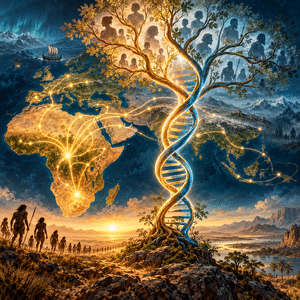
For geneticists, “scientific Adam” is the common ancestor of us all. The Y chromosome contains sequences that allow us to trace our most distant origins. Our genes carry the history of all our ancestors. Researchers have identified a common ancestor for EURASIANS (Europe and Asia), associated with the M-168 marker. This scientific Adam, also known as Eurasian Adam, lived approximately 60,000 years ago and originated in Africa. His descendants migrated out of Africa.
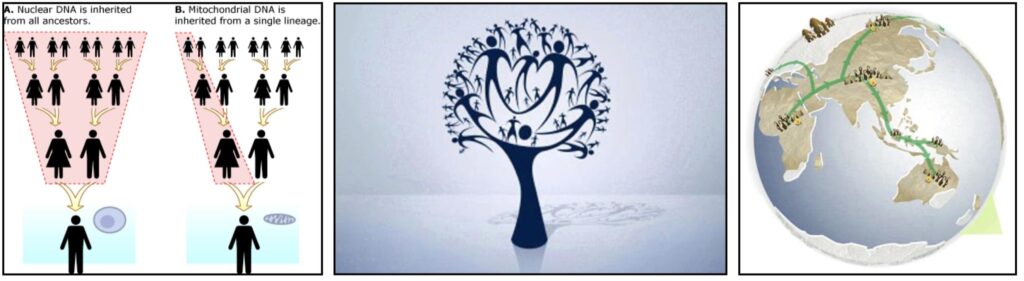
Studies of DNA (deoxyribonucleic acid) have therefore made it possible to classify a number of genealogical groups descended from a common ancestor (M-168) at some point in prehistory. These are called haplogroups. There are two types: Y-chromosome DNA (Y-DNA) haplogroups, inherited from father to son, and mitochondrial DNA (mtDNA) haplogroups, inherited from the mother. The former provides information about the agnatic (or patrilineal) lineage, while the latter traces the direct maternal lineage. Source : NHGRI.
Y-DNA haplogroups are used to determine whether two individuals with the same surname descend from a common ancestor in the relatively recent past (3 to 20 generations). STR (Short Tandem Repeat) markers are used for this purpose.
SNP (Single Nucleotide Polymorphism) tests make it possible to trace much more distant ancestral origins and identify the ancient ethnic group to which our ancestors belonged—for example, Celtic, Jewish, Germanic, Slavic, and others.
R1b is by far the most common haplogroup in Western Europe. Many Normans belong to haplogroup I. Rollo and his Vikings settled in Normandy in the early 10th century. Negotiations led to the Treaty of Saint-Clair-sur-Epte in 911. Historians regard him as the first Duke of Normandy. Several French-Canadian families also belong to haplogroup I. For example, members of the Duseau, Amireau, Bélanger, Bouchard, Tessier, Auger, Cantin, Hamel, and Lacroix families, among others, belong to this haplogroup.
SNP tests help pinpoint a lineage’s position within the genetic family tree. Comparing these results with modern and ancient DNA data can shed light on the lineage’s history and geographical distribution, without determining ethnic identity on its own.
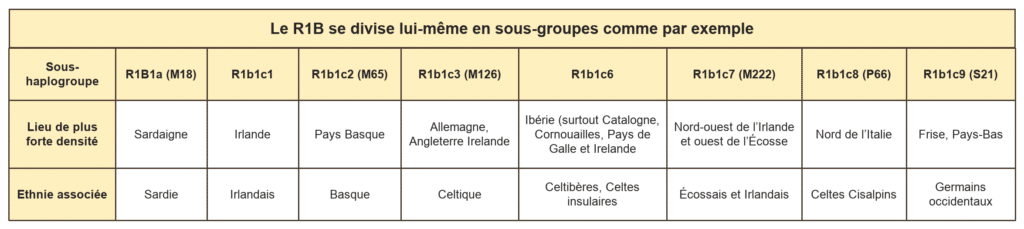
The sub-groups of the R1B
The R1B itself divides into sub-groups such as for example:
Haplogroup I
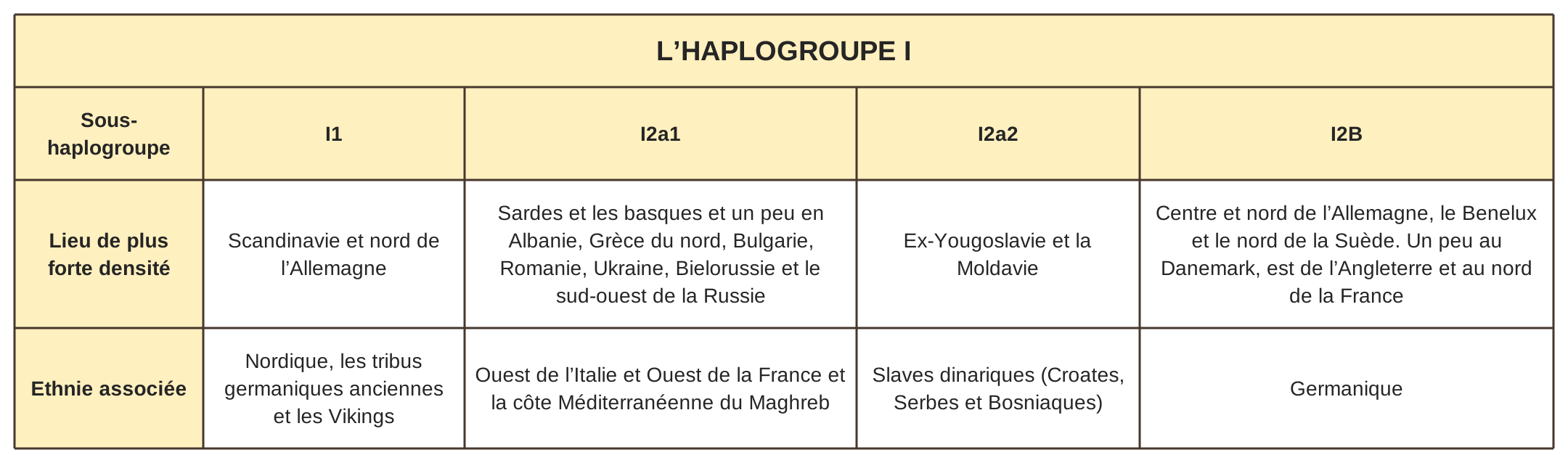
For those who wish for more technical details on the geographical distribution and ethnic origins of European haplogroups, see:
http://www.eupedia.com/europe/origines_haplogroupes_europe.shtml
http://en.wikipedia.org/wiki/Haplogroup_I1_(Y-DNA)
The French Heritage DNA Project
It was decided by your board of directors to take advantage of these scientific discoveries and participate in the French Heritage DNA Project. This decision was confirmed during the general assembly meeting held in Bécancour on October 3, 2009.
Three volunteers from the Pierre Levasseur lineage and three from the Laurent Levasseur lineage are currently participating in this project.
https://www.familytreedna.com/groups/frenchheritage/about
This French DNA Heritage Project (ADNHF) is intended for everyone who believes they have French ancestors, even distant ones. The project has been in operation since May 2005. The results (code name and surname) are deposited into a bank, which will become quite large over time.
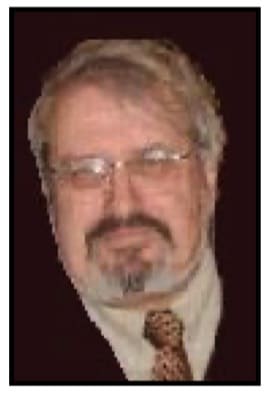 In Quebec, Mr. Jacques Beaugrand, a retired scientific researcher, is the francophone president of the association. He is a member of the Canadian-French Genealogy Society (SCGF).
We met Mr. Beaugrand in Bromont on November 7, 2009. He will analyze the DNA results and genetic lineages of six volunteers for us. Once it is confirmed that our volunteers have a common profile, we will proceed with a SNP test to determine their distant ancestral origins (Celtic, Jewish, Germanic, etc.).
Mr. Beaugrand has agreed to talk to us about DNA genealogy and to share the results of his research regarding DNA analyses on Levasseur; he will therefore be our speaker at our next gathering, which will be held in Sherbrooke in 2011.
This DNA research on some volunteers from the Laurent lineage and some volunteers from the Pierre and Jean lineage will hopefully allow us to solve some questions about the origins of the Levasseur.
1. Is Laurent a parent with Pierre and Jean Levasseur?
2. Through which migrations did the Laurent and Pierre and Jean lineages pass? The point of origin is Africa (M-168). Did they come directly from Africa to France, or did they pass through Asia, the Scandinavian countries, the Celtic countries, or through Palestine?
3. These tests would allow us to find the genetic signature of the Levasseur (Levavasseur).
Since the project is in association with France, we could over time make comparisons with Levasseur de France. We suspect that there are several groups of Levasseur in France. The surname Levasseur is quite common in France. In fact, it is the 495th most common surname in France. There are more than 600,000 surnames in France, of which 300,000 are borne by a single individual.
We invite other Levasseur to participate in this project. A large number of people participating in this study adds useful comparison points to determine the genealogical chains.
Indeed, some people who have a gap in their family tree, due to a lack of official documents, might first discover whether they are descended from Jean and Pierre, from Laurent’s lineage, or from another Levasseur lineage. A large number of participants in this research would later allow for the tracing of part of the missing family tree.
Genetic DNA will not modify our current database. Genetic genealogy begins where classical genealogy ends. The latter concludes when there are no more documents to study.
It is important to note that the purpose of this research project is not to determine whether an individual is related to the family or not. That is why the tests are anonymous. Only the surname with a sample number is known.
We therefore hope that this new tool will allow us to learn more about our origins.
Results of the DNA tests of six of our members
Who were our ancestors? Where do we come from? Most people can trace their lineage back only to three or four generations in their family tree. However, through the analysis of heredity, it is possible to look back several thousands of years.
Earlier, we wrote:
“This DNA research on some volunteers from the Laurent lineage and some volunteers from the Pierre and Jean lineage
will allow us, we hope, to resolve some questions about the origins of the Levasseur.”
Since the project is in association with France, we could over time make comparisons with Levasseur de France. We suspect that there are several groups of Levasseur in France.
 Three people from the lineage of Pierre Levasseur participated in this search. They are Roger Levasseur, Paul Levasseur, and myself (Gilles Carmel).
Three people from Laurent Levasseur’s lineage also participated in this search. They are Patrick Levasseur, Jean-Pierre Levasseur, our webmaster, and Mr. William Levasseur.
We are therefore able to answer some of these questions.
Before going further, I would like to highlight the valuable collaboration of Mr. Jacques Beaugrand. I would never have been able to decode the results of these tests without his help. He is a retired scientific researcher and is the Francophone president of the “French Heritage DNA Project”. To learn more, visit his website at: http://beaugrandjacques.ca
Is Laurent related to Pierre and Jean Levasseur?
All three descendants of Pierre Levasseur tested had an exact match across all 37 markers.
(The markers are numbered from 1 to 37.)
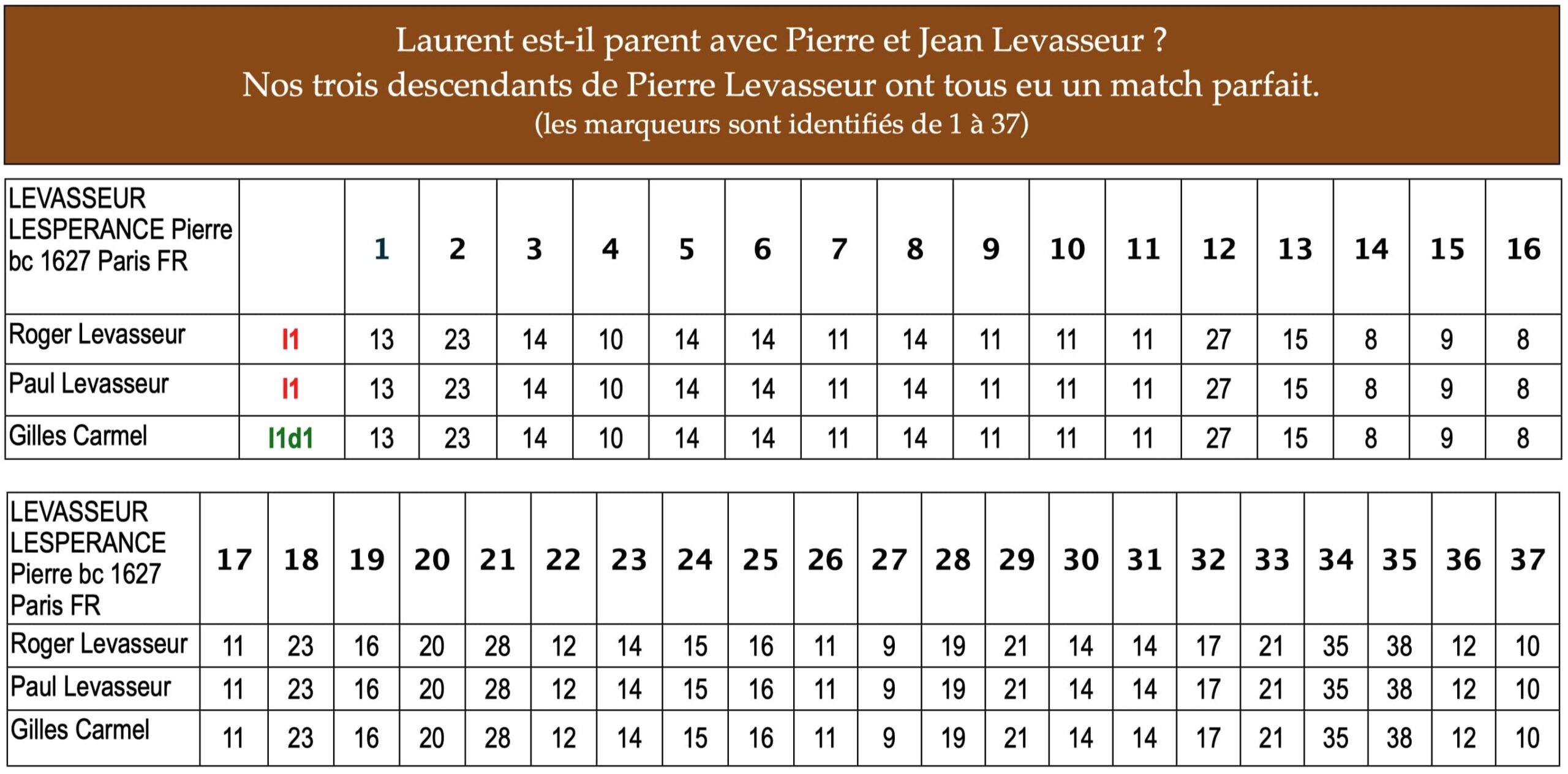
The descendants of Pierre Levasseur belong to haplogroup I. I took the sub-clade test to determine our origins with more precision.
Since our result is significantly different from the modal I1, it was decided that only one of the three of us would take this test. My I1d1 result also applies to Roger and Paul.
A first conclusion can be drawn from this result:
Some Carmel are indeed descendants of Pierre Levasseur. The common ancestor of Roger, Paul, and myself is Pierre Levasseur, son of Pierre Levasseur de Lespérance and Jeanne Chaverlange. This Pierre Levasseur was born in Quebec on April 30, 1661. He married Anne Mesnage. They had, among other children, Denis-Joseph (ancestor of Paul and Roger) and Pierre Jacques Levasseur/Carmel (my ancestor).
Descendants of Laurent Levasseur
Here are the results of Jean-Pierre, Patrick, and William Levasseur, who are the descendants of Laurent Levasseur.
The markers are identified from 1 to 37. LEVASSEUR Laurent — b 1647 FR.
Here are the results for Jean-Pierre, Patrick, and William Levasseur, who are descendants of Laurent Levasseur.
(The markers are numbered from 1 to 37.)
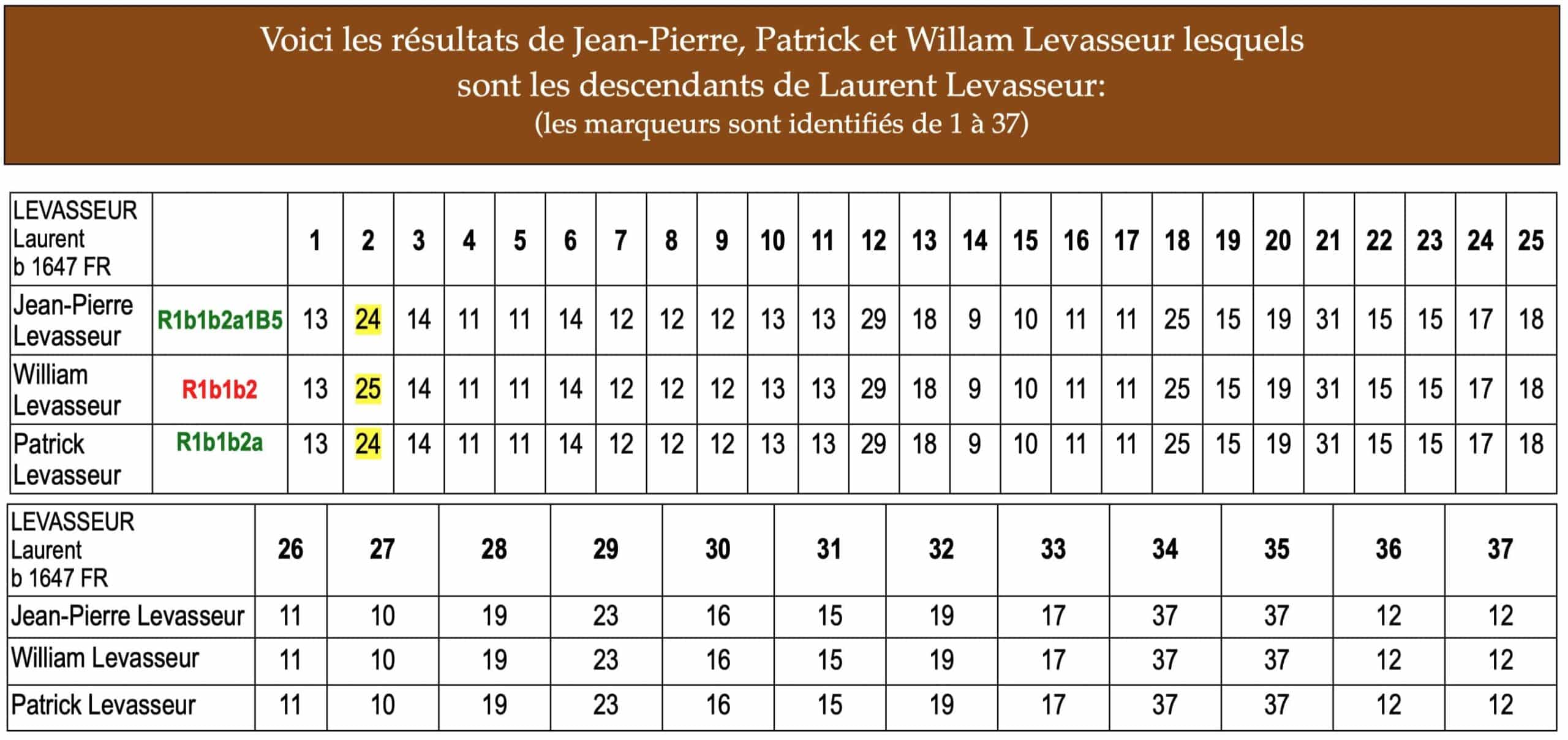
Laurent’s descendants belong to haplogroup R, more specifically R1B1B2a1b5 (L21). Jean-Pierre’s a1b5 designation is the final result of his subclade test. On the advice of Mr. Jacques Beaugrand, coordinator of FTDNA’s French Heritage project, we will carry out subclade testing for all participants descended from Laurent. Based on the WAHM (Western Atlantic Haplotype Modal), described here as the ancestor of all Western European R1b lineages. Subclade testing is therefore needed for all participants descended from Laurent to resolve any uncertainty. Jean-Pierre and Patrick have an exact match across 37 markers. William differs from Jean-Pierre and Patrick by a genetic distance of 1 across 37 markers (36 out of 37 markers match). This small difference results from a mutation at marker number 2 in one of William’s ancestors.
The observed profiles show similarities to the WAMH (Western Atlantic Modal Haplotype), a profile of STR marker values frequently found within haplogroup R1b. This profile does not represent a particular ancestor and cannot, on its own, establish a recent relationship. Additional SNP testing can identify each participant’s genetic subclade more precisely and help assess the relationships between the lineages studied.
Regarding the question, “Is Laurent related to Pierre and Jean Levasseur?”
The results indicate that the studied lineages of Pierre and Laurent Levasseur belong to distinct paternal haplogroups. This therefore allows us to rule out a recent common ancestor in the direct paternal line, without excluding any possible relationship through other branches of their genealogy.
The migrations of the tribes of Laurent, Pierre and Jean
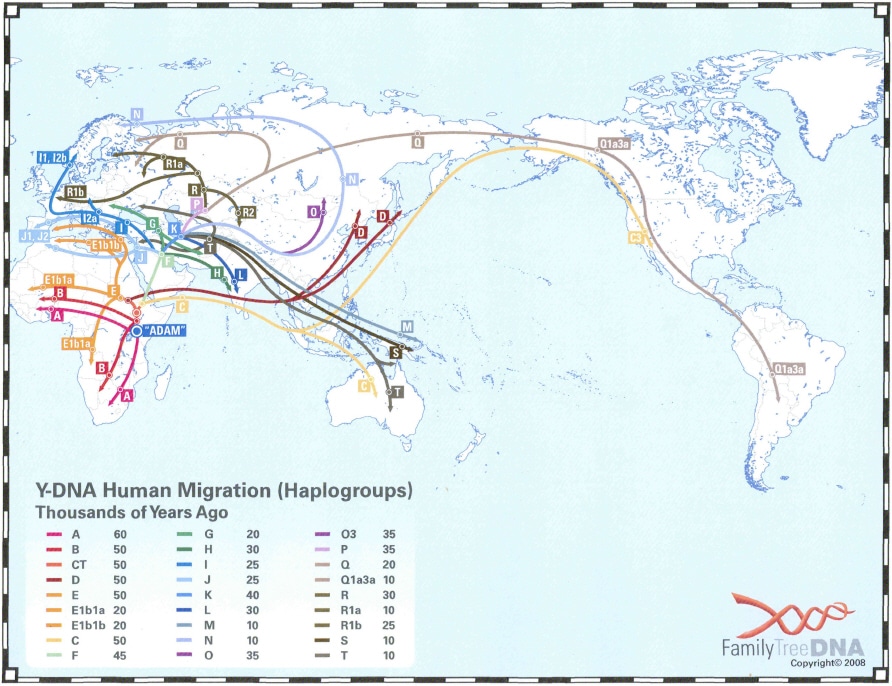 Through which migrations did the Laurent lineage and that of Pierre and Jean pass?
The origin point is Africa (M-168). Did they come directly from Africa to France, or did they pass through Asia, the Scandinavian countries, the Celtic countries, or through Palestine?
The sub-category test allows us to answer this question in general.
Pierre Levasseur
Certaines branches de cet haplogroupe sont présentes en Europe du Nord. Une contribution scandinave à l’histoire de cette lignée constitue une hypothèse à explorer, mais les résultats présentés ne permettent pas d’établir une ascendance viking particulière.
I invite you to download and read the document “Where Did European Men come From” by Kavi Wiik, published in the Journal of Genetic Genealogy. http://www.jogg.info/41/Wiik.pdf
Laurent Levasseur
Currently, we only have Jean-Pierre’s test results. Mr. Jacques Beaugrand informs us that the regions affected by R-L21 (R1b12a1b5) are British, Irish, and possibly northern France. This group is also common in Germany (Sachsen region) and Scandinavia, but rare among Iberians and in Italy.
I invite readers to visit the website of the International Society of Genetic Genealogy (ISOGG). This website is regularly updated. New sub-groups are added following new results. The tables provided in my December text have already been modified by the creation of new sub-groups.
http://www.isogg.org/tree/index.html
The genetic signature of Levasseur and the other families
These tests would allow us to find the genetic signature of Levasseur (Levavasseur). The FTDNA database currently does not have a Levasseur from France.
However, the results of the DNA tests on the descendants of Pierre and Laurent allow us at the moment to find similarities with other families.
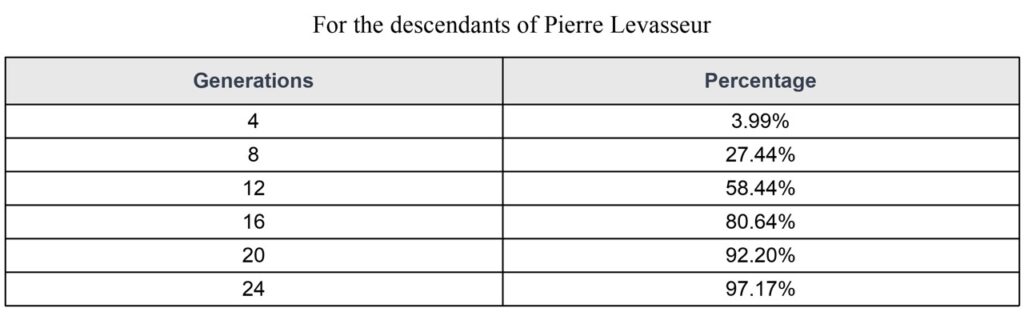
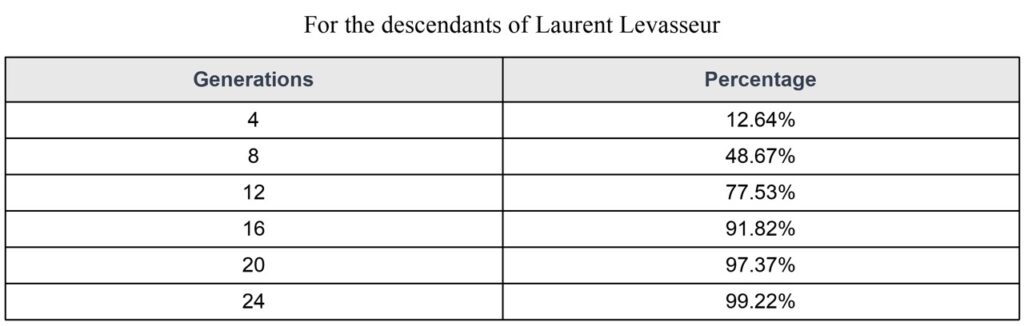
This kinship with other families dates back to 24 generations or 1,000 years ago. At that time, surnames were not yet fixed. The creation and fixation of family names in France dates back to Louis XI (Royal edict of 1474). The process of family names began in the 10th century for the nobility and in the 12th century for the general population. In 1474, Louis XI prohibited changing one’s name without royal permission.
In 1539, Francis I promulgated the ordinance of Villers-Cotterêts. This ordinance made it mandatory to keep civil registry records. This task was entrusted to the curés, with the clergy constituting the only “administration” present throughout the kingdom. In fact, the royal decision formalized and generalized a practice that had already been in use since the previous century, primarily in cities.
Vavasseur (vassal of the vassal) was changed for some people to Levasseur, Vasseur, Vasseur, Vassor, Lavassor, Carmel, Carmell, etc.
Family Tree DNA (FTDNA) informs us of matches with the descendants of Pierre or Laurent. Additionally, we receive an email alert of new “matches” when they are discovered. Here are the results obtained:
For the descendants of Pierre Levasseur
The Chisholm families (Scottish clan) have many correspondences with us. Many Chisholm have a match of 25 distance -1 and 25 scorers distance -2, and one Chisholm has a match of 37 scorers distance -4.La famille Hamby a aussi beaucoup de similitude avec un de ses membres ayant également un match de 37 marqueurs distance -4.
According to the model used at the time, the comparisons suggested a high probability of sharing a common paternal ancestor in the last 24 generations. These estimates remain dependent on the model and do not allow for the precise dating of this ancestor.
The descendants of Pierre have similarities with Finnish and Russian families. In the United States, there are Dusseau and Petit (Little) who are also very close.
Therefore, Vavasseur and Levasseur probably began between 1100 and 1474. That is why we will find families of relatives or near relatives with different surnames but having the same DNA or very similar DNA.
For the descendants of Laurent Levasseur
Similarly, the Shelton, Liedebrand, Wilbanks & Allen families are very close. Some of these families originate from the Saxony region in Germany. There is also a Viking possibility. A Shelton member is genetically related to 37 markers (distance -4) with the descendants of Laurent Levasseur. The FTDNA chart calculates a 99.22% match between Laurent Levasseur’s descendants and this Shelton.
You want to participate in the French Heritage project
A genetic test allows you to discover which haplogroup you belong to, which ancient people and country your ancestors originated from, and it gives you the opportunity to find relatives around the world. A saliva sample is sufficient to create your genetic profile. This profile will be compared in the database so that we can see with which you genetically match. The FTDNA (French Heritage is associated with FTDNA) database is the largest in the world, with more than 200,000 people registered from all countries.
The result of the analysis is an interpretation of your geographical origin and provides unlimited access to the database. In this way, you will be able to get in touch with these people and learn more about your family’s history. You are invited to contact the author of this article for more details or to visit the French Heritage website.
Join the “Levasseur” group on FamilyTreeDNA
http://www.familytreedna.com/public/levasseur/
 The Levasseur group on DNA research was created to bring together the various Levasseur lineages in groupings of descendants of the Levasseur ancestors.
ALL Levasseur surnames are invited to join this project, regardless of the variations of the name or nicknames (Levasseur, Carmel, Vasseur, Vassor, Borgia).
DNA analysis gives us an exceptional tool to identify participants who share the same male ancestor, and allows us to link people bearing the surname Levasseur, even if we believe they are not related.
For your information, we are one of the few founding families in Quebec to have undertaken such a project. The Smiths count on more than 1,400 members! We are not aiming for such a level of participation, but we believe it is not unrealistic to bring together around twenty Levasseur members in this project from various regions of America and Europe.
If you haven’t passed the test and would like to purchase a test kit to join the project, simply click on this link.
http://www.familytreedna.com/group-join.aspx?&group=Levasseur&vGroup=levasseur
To obtain additional information about this article or the ADN project, you can contact the author, Gilles Carmel, or Cheryl Vassaur, responsible for the development of the ADN Levasseur component, Carmel and Vassaur, at the address: [email protected].

